
How to ship comic books flat, safe, and without corner dings
Bag and board sizes, the cardboard sandwich that stops spine creases, box sizes for lots and short boxes, and the Media Mail rule that trips up a lot of sellers.
- Every comic: in a bag with a backing board, flap taped to the bag (never the comic).
- 1 to 3 comics: sandwich between two pieces of corrugated cardboard and ship in a comic book mailer.
- Lots of 4 to 20: stack bagged and boarded books flat in a snug small box with cardboard top and bottom.
- Don't use Media Mail. USPS doesn't allow most comic books in Media Mail because they contain advertising.
Comic books are paper, staples, and a spine that creases if you look at it wrong. Buyers grade with their eyes the second they open the package, and a new spine stress line or a dinged corner is enough to start a return or an argument. Most comic shipping damage comes from the book bending, not from being crushed, so the whole goal is to keep it perfectly flat.
Here's how to pack single issues, lots, short boxes, and graded slabs, plus what to know about Media Mail before you print a label.
The basic comic book pack
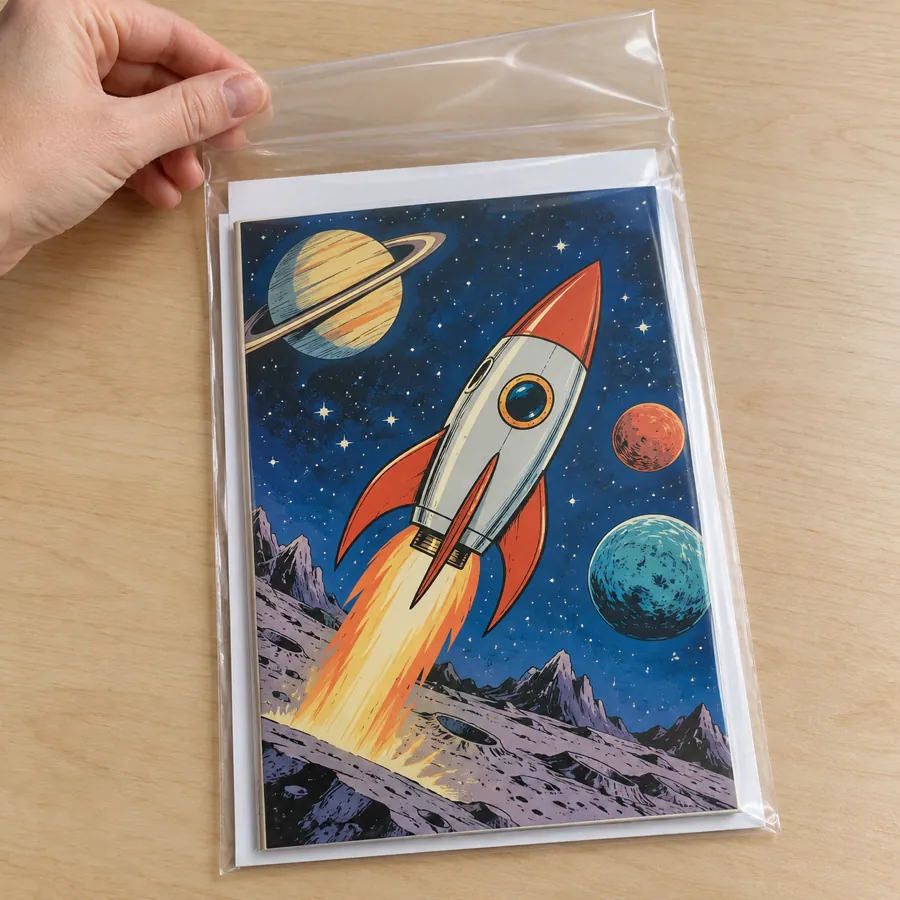
Step 1. Bag and board the comic.
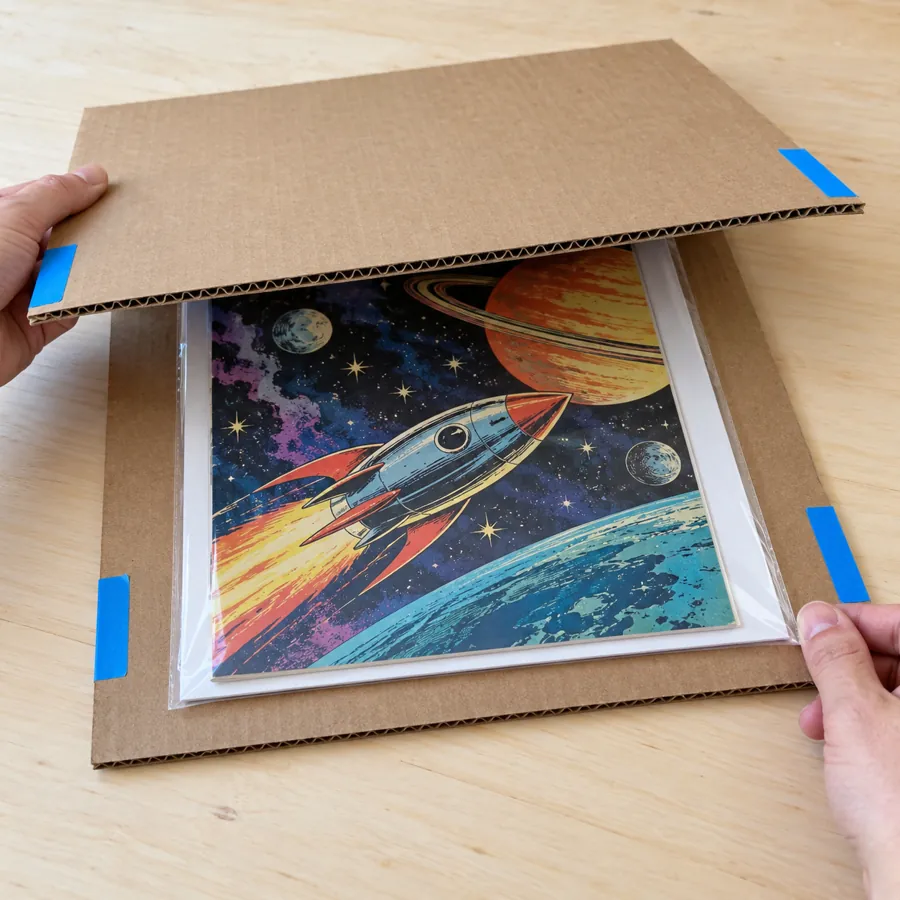
Step 2. Sandwich it between two sheets of cardboard a bit bigger than the comic.
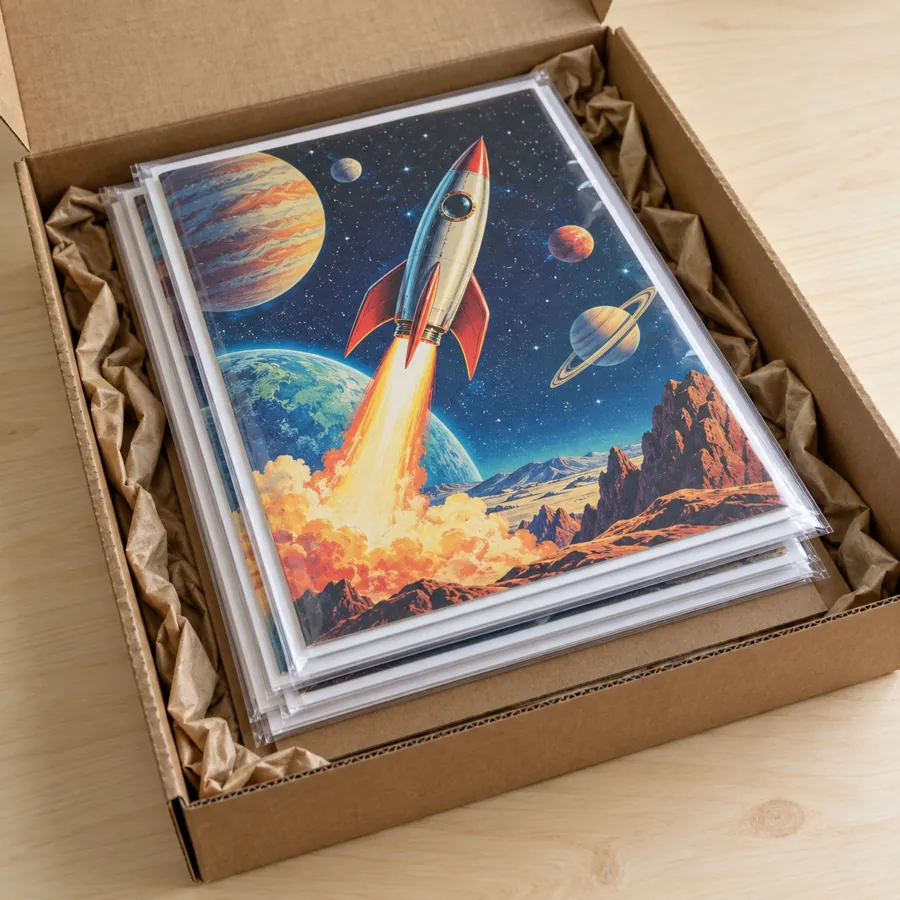
Step 3. Lots: pack bagged comics snugly in a box so they can't shift.
- 1Top cardboard. Corrugated, cut about an inch bigger than the bag on every side.
- 2Comic in its bag, board behind it. The board keeps the spine and pages from flexing.
- 3Bottom cardboard. Same size as the top, taped to it around the edges.
- 4Mailer or box. A comic mailer or snug box so the sandwich can't slide.
Every comic should go out in a bag with a board, even cheap ones. Put the board behind the comic, slide both in together, and tape the bag flap closed against the back of the bag. Tape should never touch the comic itself.
Then build the cardboard sandwich. Use corrugated cardboard (the kind with the wavy middle layer), not thin cereal box board, and cut it at least an inch larger than the bag on every side so the corners of the comic are never the first thing to hit anything.
Bag and board sizes by comic era
Comics changed size over the decades, and a bag that's too small will curl the edges while a bag that's too big lets the book slide around. These are the common bag sizes; boards are slightly smaller so they fit inside.
| bag size | approx. bag dimensions | fits |
|---|---|---|
| Current / Modern | 6⅞" × 10½" | Most comics from the late 1970s to today |
| Silver Age | 7⅛" × 10½" | Roughly late 1950s to early 1970s |
| Golden Age | 7¾" × 10½" | 1930s to mid 1950s, wider books |
| Magazine | 8¾" × 11" | Magazine-size comics and many treasury-adjacent books |
Not sure what era you've got? Measure the comic's width. If it's wider than about 6⅝", go up a bag size.
How to ship one to three comics, step by step
- Bag and board each comic, board behind the book, flap taped to the bag.
- If you're shipping more than one, stack them with all the spines on the same side.
- Cut two pieces of corrugated cardboard about an inch larger than the bags on every side.
- Place the comics between the cardboard and tape the edges all the way around so nothing can slide out.
- Slide the sandwich into a comic book mailer or a snug flat box. A cardboard comic mailer sized for modern books is around 11" × 8"; it should hold the sandwich without room to shift.
- Seal it and give it a gentle shake. If you can feel the sandwich sliding, add crumpled paper. Writing "Do not bend" on the outside is fine too, but the cardboard is what actually protects the book.
Skip the plain bubble mailer for comics on its own. Bubble wrap protects against bumps, not bends. Without the cardboard sandwich, a comic in a bubble mailer can still fold in half in a mailbox or a sorting bin.
Shipping comic lots and short boxes
For lots of about 4 to 20 books, stack them flat (bagged and boarded), add a sheet of corrugated cardboard on the top and bottom, and pack them in a snug box. Something around 12" × 9" × 3" holds a decent stack of modern comics. Fill any gap with crumpled paper so the stack can't shift, and never stand single issues on their edges in a big box with empty space.
A small, heavy box like this is often a great fit for Priority Mail Cubic, where you pay by box size instead of weight. See our guide to Priority Mail Cubic pricing to check if it saves you money.
Shipping a full short box or long box? Those storage boxes aren't built for the mail. Fill any empty space inside so comics can't flop over, tape the lid down, then put the whole thing inside a sturdier shipping box with a couple of inches of padding on every side. A full short box is heavy, so compare USPS Ground Advantage against UPS and FedEx Ground.
Can you ship comic books with Media Mail?
Usually, no. Media Mail is cheap, which makes it tempting, but USPS rules say Media Mail packages can't contain advertising, and USPS specifically says comic books don't meet that standard. Media Mail packages can be opened and inspected, and if yours gets flagged, it can come back to you or arrive with postage due for the buyer. That's a bad look for a seller.
Trade paperbacks and graphic novels with no advertising are a gray area, and some post offices treat them as books. If there's any doubt, ship with USPS Ground Advantage instead and don't risk it.
How to ship graded comics (CGC and CBCS slabs)
Graded comic slabs are bigger than most people expect, roughly 8" × 12¾" for a modern-size slab, and the plastic can crack or scratch.
- Put the slab in a slab bag to protect the case from scuffs.
- Wrap it in two layers of bubble wrap, paying extra attention to the corners.
- Pack it in a box with at least an inch or two of padding on every side, so the slab never touches the box walls.
- USPS Priority Mail and Ground Advantage include up to $100 of insurance. For key issues and high grades, insure the full value and add signature confirmation.
Common comic shipping mistakes
- Rubber bands around a stack. They dent the edges of every book they touch.
- Tape on the comic or the bag's open edge. Tape the flap to the back of the bag only.
- Thin cardboard instead of corrugated. Cereal box cardboard bends right along with the comic.
- Loose books in a big box. They slide, flop, and crease. Snug beats roomy every time.
- Using Media Mail to save a couple of dollars. It's not allowed for most comics, and the buyer may end up paying postage due.
Supplies checklist
- Comic bags and backing boards in the right era size
- Cardboard comic book mailers
- Corrugated cardboard sheets or pads
- Small flat shipping boxes for lots
- Slab bags and bubble wrap for graded books
- Packing tape
Not sure which mailer or box it fits in? Measure your packed item and drop the numbers into the free BoxSizeFit calculator. It matches you to the smallest USPS, UPS, or FedEx box or bubble mailer that fits, for eBay, Etsy, Poshmark, and Depop.
Open the box size calculatorFrequently asked questions
What's the best way to ship a single comic book?
Bag and board the comic, sandwich it between two pieces of corrugated cardboard cut an inch larger on every side, tape the edges, and ship it in a cardboard comic book mailer with tracking.
Can you ship comic books Media Mail?
Usually not. USPS doesn't allow advertising in Media Mail and specifically says comic books don't meet that standard. Ship with USPS Ground Advantage instead to avoid the package coming back or arriving with postage due.
What size box do I need to ship comic books?
A cardboard comic mailer around 11 by 8 inches fits one to a few modern comics with a cardboard sandwich. For lots, a snug box around 12 by 9 by 3 inches holds a stack of bagged and boarded modern books.
Can I ship comics in a bubble mailer?
Only with a corrugated cardboard sandwich inside. Bubble mailers stop bumps but not bends, and bending is what causes spine stress and creases.
How do you ship a CGC graded comic?
Put the slab in a slab bag, wrap it in two layers of bubble wrap, and pack it in a box with an inch or two of padding on every side. Insure valuable books for their full value and add signature confirmation.